PRESS RELEASE
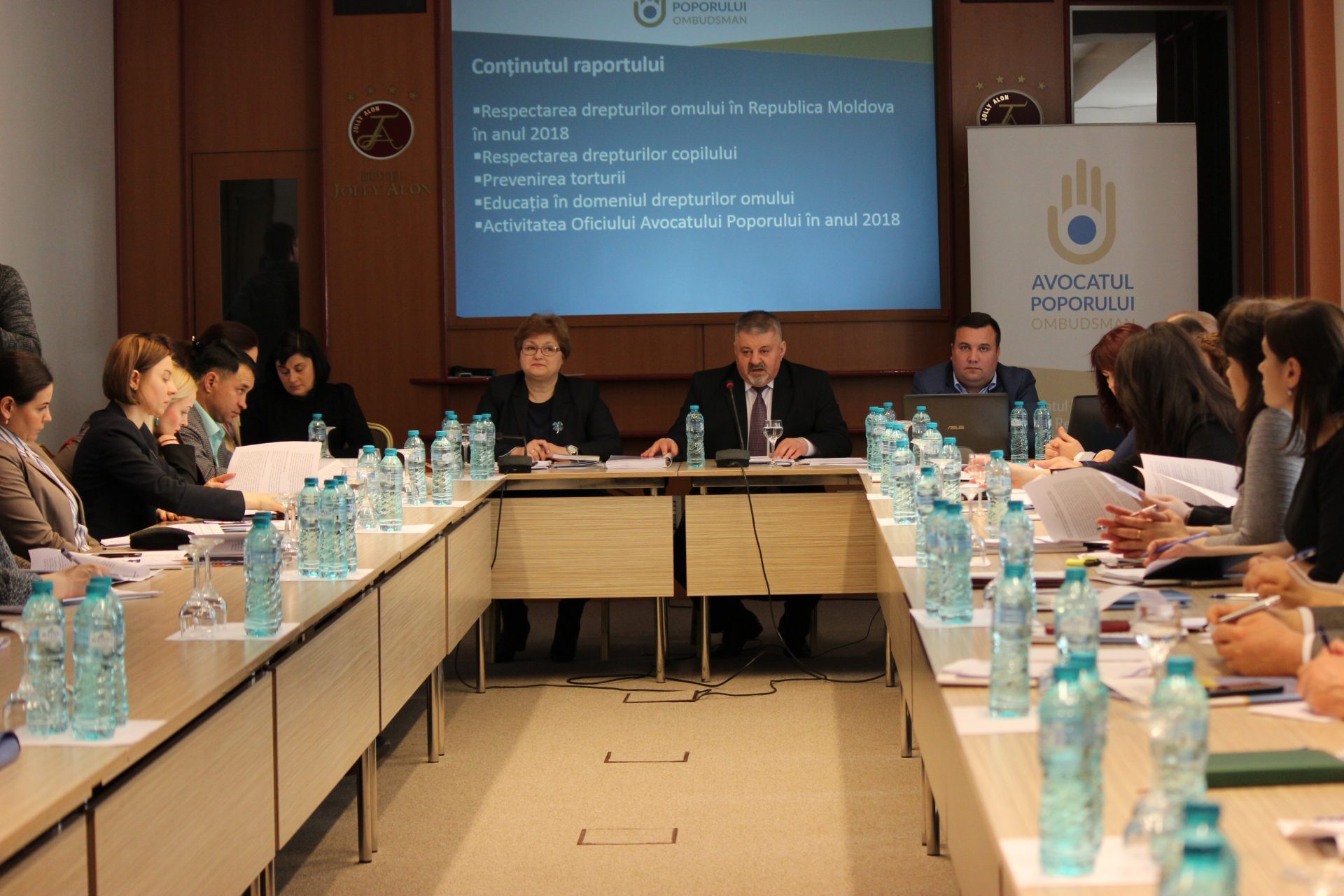
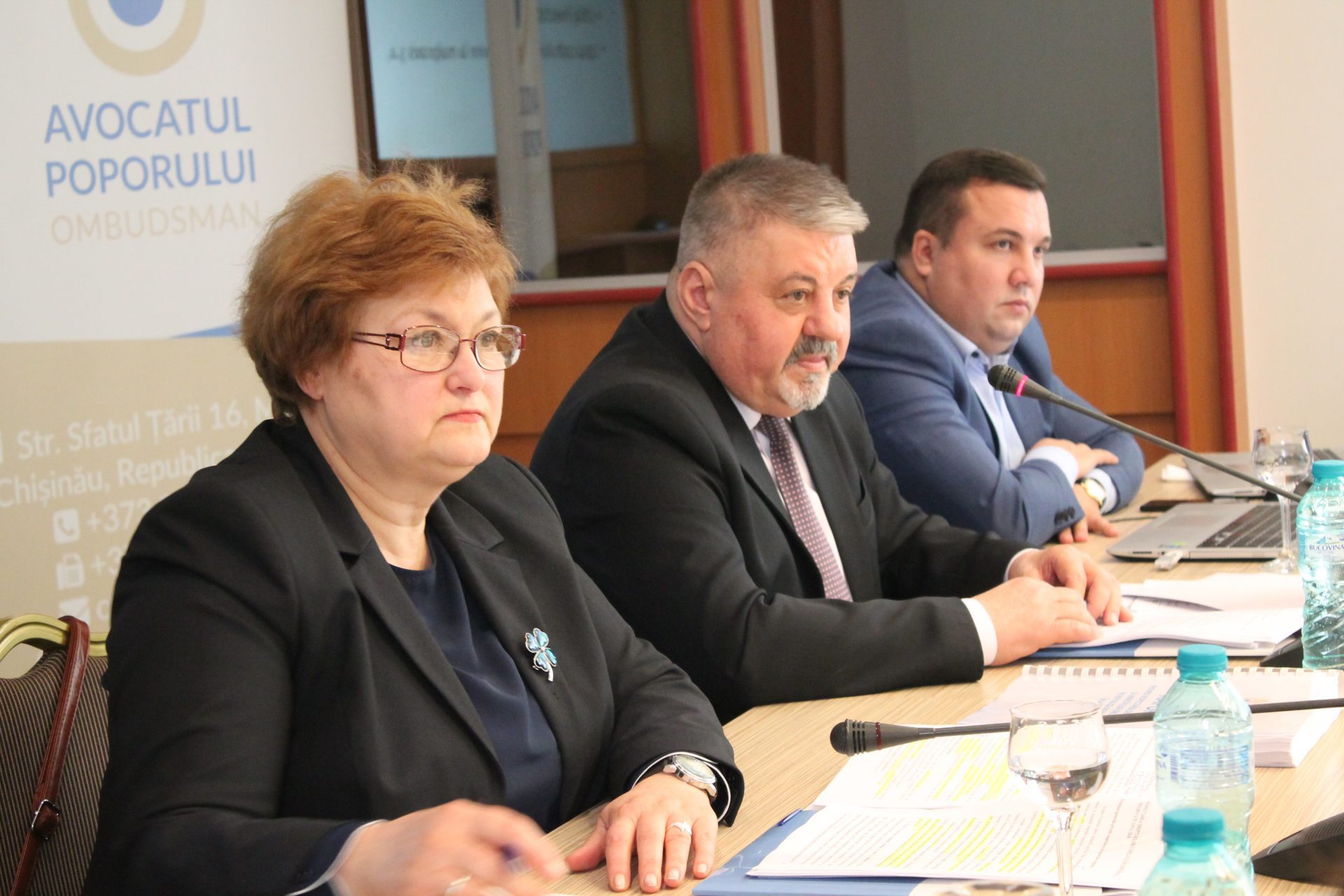
Situation in the field of human rights in 2018 year was not improved; in some fields it even became worse. It is the opinion of People’s Advocate, Mihail Cotorobai and People’s Advocate for children’s rights, Maia Banarescu made public during the event when presenting the Annual Report of Ombudsman on observance of human rights and fundamental freedoms in 2018.
According to the statements of People’s Advocate it can be spoken about a continuous degradation in the last year of the situation related to access to justice, freedom of speech, observance of the rights of detainees, to elect and be elected, the right to medical care.
Speaking about the situation in the field of justice, Mihail Cotorobai mentioned that the reforms in this field resulted with the expected results. No new instrument of policies for ensuring the continuity of reform in the sector of justice was adopted despite the fact that the authorities have mentioned the necessity for elaborating such an instrument of policies and in November 2017 it was presented a new concept of the Strategy for Justice Sector Development for 2019 – 2022. The package of laws on hate and bias based crimes was not adopted. People’s Advocate spoke about the existent barriers in exercising the activity of lawyers and that their removal is an essential condition for ensuring the realization of fundamental right to an equitable process of all parties.
In this context, Mihail Cotorobai mentioned that during 2018 year there were not registered significant evolutions referring to respect of individual freedom and safety of person, the specific problem remaining to be the excessive application of custody on remand. People’s Advocate considers that custody on remand should be an exception of the right to freedom and safety and to be applied in cases in which there are presented certain evidences accompanied by arguments which would confirm with certitude the probability of committing actions by the suspects.
Referring to legal status of foreign persons and stateless persons, the Ombudsman reiterated his view point made public in case of the group of persons of Turkish origin from the administration of Theoretical Lyceum „Orizont” expelled by the Moldovan authorities under the pretext of existence of some threats to the address of the national security: by the mentioned action the international engagements on observance of human rights assumed by the Republic of Moldova were defied in a flagrant way. The Ombudsman reaffirmed its urge to the authorities that before making the decision on expulsion to analyse in details the risks to which the person can be supposed to and the consequences of his/her expulsion. He emphasized that although the European Convention does not guarantee the right to get asylum, the state which makes the expulsion is obliged to abstain from removal of person who is exposed to the risk of death or maltreatment in the destination state.
In the context of observance of the right to vote, the Ombudsman reminds the fact that the development partners and international and regional bodies of human right protection exposed critics referring to non-validation of local elections of Chisinau municipality, but also the change of electoral system. Mihail Cotorobai also stated that he has tried to bring clarity on exercising the right to vote by the citizens of the Republic of Moldova who are abroad and for this purpose he submitted a notification to the Constitutional Court in which considered that the requirement of exclusive presentation of passport or seaman’s license for exercising the right to vote by the citizens who are abroad is disproportioned. Or, the realization of the legal in view purpose – that of citizenship certification and eligibility of voters can be done with any identity document, inclusively with the one which is expired. But by the decision of January 14, 2019, the Constitutional Court declared the Ombudsman’s notification as being inadmissible.
Speaking about to freedom expression, People’s Advocate appreciated that 2018 year was marked by hate speeches in the public space, attacks on press and lack of adequate reactions by the competent institutions, restrictions imposed to journalists in the access to events and some public interest information. The cases of information manipulation and distribution of false information became more frequent. The editorial independence of information means in press has continued to be affected by the pressures made by the owners of mass communication means, political or commercial interests.
In the Ombudsman’s opinion, in 2018 neither the state of things referring to information access was improved. Persons, journalists or the representatives of civil society continue to face the same difficulties when getting public interest information, as would be the difficult procedure of getting information; failure of public servants in respecting legal terms for its issue; partial issue of requested information or failure of issuing it; application of Law on petitions in case of information request; refusal to issue the information due to reason of personal data protection or due to the fact that it represents a state secret.
On a different note, the Ombudsman recommends to the authorities to ensure the realization of freedom to assemblies without non-justified restrictions and obstacles in law and practice and undertaking the corresponding measures for ensuring that the organizers and participants to assemblies do not face intimidation actions, including interferences of police before organizing the assemblies.
People’s Advocate emphasized that in the opinion of population the right to healthcare remains to be one of less respected rights, based on the survey of perceptions realized by People’s Advocate Office in 2018.
Despite the changes of the healthcare system, implementation of different reforms designated to improve this field, the beneficiaries of healthcare services continued to invoke in their notices to Ombudsman the violation of human rights in the field of health protection, especially referring to: failure to respect the condition of getting the patient informed consent; failure of doctors to respect professional ethics; lack of correct informing; faulty communication between the doctor and patient; lack of discretion when providing medical care services (confidentiality); limited access to specialized treatment; low quality of medical care services; limited access to expensive treatments; lack of legal framework on malpractice etc.
At the chapter social protection there are also no essential improvements.
People’s Advocate draws attention on the recommendations of the European Committee of Social Rights in the conclusions referring to monitoring the implementation of the European Social Charter (revised) by the Republic of Moldova: situation of the Republic of Moldova is not in line with the dispositions of the article 12 §1[1] of Charter due to the fact that the social security system does not cover a significant percentage of population; the minimum quantum of unemployment compensation, pension age limit, indemnity in case of illness is not adequate.
Speaking about the observance of the rights of persons with disabilities, Mihail Cotorobai appreciated the harmonization of provisions of the article 51 of the Constitution of the Republic of Moldova with the standards of UN Convention on the rights of disabled persons, by changing the notion of „disabled persons” in ”persons with disabilities”, as it was recommended several times in the previous reports.
The Ombudsman also appreciated the fact that during the reference year it was approved the National program on deinstitutionalization of persons with intellectual and psycho-social disabilities from residential institutions managed by the Social Assistance National Agency for the period 2018-2026 and the Action plan on its implementation[2] which provides the realization of the deinstitutionalization of persons with disabilities from residential institutions by providing social services on the community level and transformation of residential institutions into regional centres with attributions in development and providing alternative services on the community level. In 2018 the process of establishing the disability degree reform also took place. However, People’s Advocate draws attention on difficult procedure on establishing the disability degree. The Ombudsman also recommends the implementation by the authorities of measures on ensuring the access of persons with disabilities to social infrastructure, establishing of an efficient implementation and control mechanism for the observance of accessibility requirements on all stages, projection, authorization, execution and use of constructions.
In the Report it is also spoken about the alarming situation on observance of human rights and freedoms in the administrative-territorial localities of the left bank of Nistru river. It is spoken about the state of things in which are the persons placed at the Psycho-neurological institution of Tiraspol; forced enrolment in „Transnistrian armed forces”; problems related to documentation of people from the administrative territorial regions of the left bank of Nistru river and Bender mun. (Transnistria); cases related to observance of individual freedom and safety of person, physical and mental integrity; existent impediments in the realization of rights to circulation, property, assistance and social protection.
People’s Advocate also appreciates the establishment of this dialogue platform between Chisinau and Tiraspol, being given the fact that it is offered the possibility to discuss about the problems which face the persons of the left bank of Nistru river, out of political framework, but based on obligations to respect the fundamental human rights. By this way it is also succeeded promoting international standards in human rights field for being taken over and implemented by the in fact authorities of the region, but also finding out about the problems which face the population of the region.
Referring to the situation of detention places, the Ombudsman appreciates that currently the placement of persons into custody in our country can be qualified as the placement into custody in detriment of the art.3 of Convention of European Jurisprudence.
In 2018 the discussions on status and model of medical system of penitentiaries went viral. CAT/ CPT recommended to the Government to transfer medical units under the management of National Authorities of Penitentiaries (NAP) in the subordination of the Ministry of Health with the title of solution against the malfunction of medical services in the penitentiary system. Currently, NAP is in a process of discussions for identifying the optimal model.
The Ombudsman found that the penitentiary authorities, contrary to the articles 2 and 3 of ECHR do not ensure the comprehensive record on health condition of person deprived of freedom and the treatment provided while being under custody; medical diagnosis and medical care are not prompt and adequate (ex: Cosovan case etc).
People’s Advocate observed that the courts continue issuing arrest warrants, despite the restriction to place in custody on remand the persons with serious diseases (art.176 CPC). And NAP being governed by Order 331/2006 tolerates detention of persons based on an arrest warrant in the penitentiary conditions up to their health condition worsening, so that the recovery of their health condition becomes impossible.
On December 31, 2018, in the system of the penitentiary administration were on record 130 patients with AIDS, through them 30 new cases and 7 cases reconfirmed or transfer from other states. 139 persons under custody benefited of antiviral treatment during the year. The Ombudsman registered claims on placement of ill persons in isolators in the basements of penitentiaries, conditions in which the disease progresses.
In the last year, 28 persons under custody deceased in the penitentiary system, 6 of them by suicide. In all the cases of death, the Ombudsman took notice ex officio. In three cases there were suspicions of death in doubtful conditions.
The Ombudsman also notes that the detention after 72 hours in the isolators of custody on remand is continuing to be applied. People’s Advocate found out about persons who stayed more than 3 days in Briceni PI (1 person – 6 days and the second – for 9 days); Soroca PI (2 persons with arrest warrant), Basarabeasca PI (1 person 4 days); Cahul PI (2-3 months). Through the reasons of staying more than the term of 72 hours is invoked the lack of identity documents; especially the placement is maintained upon the request of prosecutors or judges. The Ombudsman emphasizes that practices like these follow to be abolished. The bodies of prosecutor’s office and courts are obliged to respect the law. Detention in the police isolators cannot exceed 72 hours; this norm is imperative and follows to be respected. No document can exceed the fundamental guarantees.
People’s Advocate for children’s rights, Maia Banarescu also appreciates the effort of state in ensuring the observance of children’s rights, but she attests the existence of some numerous system problems in all the fields of human rights. In her opinion the policies of the state for the issue of children’s rights are faulty implemented due to the lack of some efficient mechanisms and procedures for realization, and due to the lack of attitude, incompetence of some servants with attributions in the field of human rights.
Referring to observance of children’s right to family name and citizenship, People’s Advocate for children’s rights mentions that the problems related to the documentation of children, especially the children of the left bank of Nistru river weren’t settled, a major impediment being the human factor which delays the documentation procedure (not being familiarized with the normative framework, not-respecting the internal working procedures).
De jure, the situation of children of the left bank of Nistru river is not known by the constitutional authorities of the Republic of Moldova. The Children’s Ombudsman has no access to the territory of the left bank of Nistru river, fact which represents a serious obstacle in monitoring the observance of children’s rights in this region.
At the chapter children’s right to family, People’s Advocate for children’s rights finds that it remains actual the problem related to the establishment of schedule for meetings in case of divorce of parents and establishing the domicile of child with one of parents. Another problem at this chapter is the illegal removal of child from the country without the consent of the second parent, respectively, the Children’s Ombudsman informs that neither the parents, nor the authorities have no pertinent solutions for this situation.
Children’s Ombudsman reiterates her previous recommendations on observance of the rights of children with disabilities of the thematic surveys Thematic Report „Social inclusion of children with disorders of the autism spectre in the Republic of Moldova” [3], Special Report „Evaluation of the situation of children placed in the boarding schools for children with mental deficiencies of Orhei and Hancesti in the deinstitutionalization process”[4], „Report on social inclusion of children with sensorial disabilities”.
Children’s Ombudsman appreciates the effort of the state to increase the quantum of some social benefits for children and families with children, but she accentuates that according to the last statistical data, the birth rate in the Republic of Moldova is continuously decreasing [5] : of about 38 thousand children born in 2014-2015 to 34 thousand in 2017.
Children’s Ombudsman concludes that in conditions like these, in approximately 15-20 years the Republic of Moldova risks to achieve a population rate of about 70%. Maia Banarescu pleads for adopting some policies in the field of protection: „of the rights of the future generations”.
Another problematic subject treated by People’s Advocate for children’s rights is the death of children of early age due to the parental/legal representative negligence or other persons they are rested with. In the last year the number of children – victims of crimes provided by Criminal Code, Chapter II „Crimes against life and health condition of person”, constitutes 91 if compared with 23 during 2017[6]. Maia Banarescu also refers to the problems related to the observance of the right to life of premature baby. According to statistical data, every year there are in average 2000 of premature babies, number which represents 7% of total number of child births [7].
In the context of the right to health, the Children’s Ombudsman reaffirms her position on mandatory vaccination of children and indicates on the compulsoriness of parents to ensure the vaccination of children and compulsoriness of public authorities to ensure the quality of vaccine and respecting with severity medical-sanitary conditions of the vaccination process.
Children’s Ombudsman reiterates that the problems on the right to education discussed in the Report on observance of children’s rights for the previous years (2016, 2017) remain in force, being insufficiently considered by the competent institutions, without being identified solutions and the distinguishable results of these solutions are lacking. The recommendations of Ombudsman on educational inclusion of children with disabilities also weren’t considered.
In another train of thoughts, the Ombudsman notes that the number of convicted children in the Republic of Moldova broadly remains constant, fact which demonstrates that the policy of the state in the field of prevention and fight against criminality through children is inefficient and it needs to be improved.
A problem analysed by People’s Advocate for children’s rights in the Report is the situation of
[1] Să stabilească sau să mențină un regim de securitate socială.
[2] Hotărîrea Guvernului R. Moldova nr.893 din 12.09.2018 cu privire la aprobarea Programului naţional de dezinstituţionalizare a persoanelor cu dizabilităţi intelectuale şi psihosociale din instituţiile rezidenţiale gestionate de Agenţia Naţională Asistenţă Socială pentru anii 2018-2026 şi a Planului de acţiuni privind implementarea acestuia;
[3] https://old2.ombudsman.md/wp-content/uploads/2018/10/raport_tematic_autismul_0.pdf
[4] https://old2.ombudsman.md/wp-content/uploads/2018/10/raport_diz_2017_red_0.pdf
[5]http://statbank.statistica.md/pxweb/pxweb/ro/20%20Populatia%20si%20procesele%20demografice/20%20Populatia%20si%20procesele%20demograficePOP030/POP030100.px/table/tableViewLayout1/?rxid=2345d98a-890b-4459-bb1f-9b565f99b3b9
[6] http://politia.md/ro/advanced-page-type/rapoarte-si-evaluari?page=3
[7] https://old2.ombudsman.md/news/fiecare-copil-are-dreptul-la-cea-mai-buna-stare-de-sanatate-si-a-beneficia-de-servicii-medicale-de-inalta-calitate-tratament-si-recuperare/